
If you tried to map poverty in the United States today, you wouldn’t just circle low-income neighborhoods.
You’d circle hospitals, emergency rooms, billing offices, and insurance call centres.
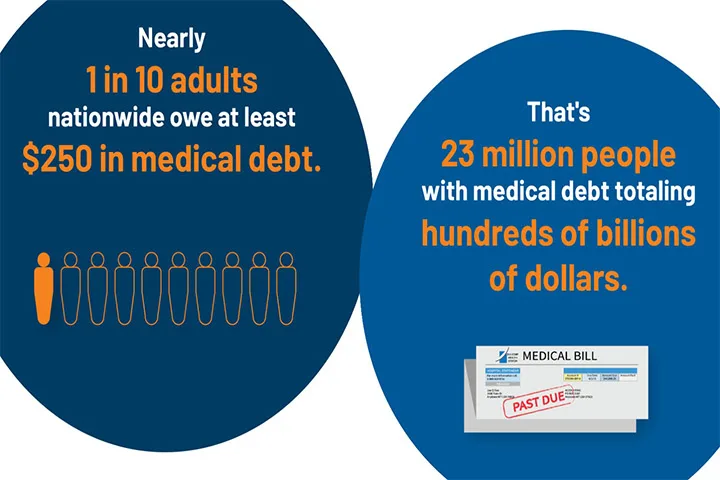
More than a hundred million people in America are carrying some form of medical or dental debt. Estimates suggest that households together owe around two hundred billion dollars tied directly to health care. For many families, that number doesn’t live in spreadsheets — it lives in unopened envelopes, collection calls, and the constant anxiety of “What if something else goes wrong?”
Medical debt is no longer just a personal finance problem. It has quietly become one of the main engines of modern American poverty.
In this article, we’ll look at:
- What medical debt really looks like in everyday life
- How it pushes people into long-term financial hardship
- Why recent credit-report changes help, but don’t fix the problem
- What individuals, communities, and policymakers can actually do
What Medical Debt Really Looks Like
When people hear “debt,” they usually think of choices: buying a car, swiping a credit card, signing a mortgage.
Medical debt is rarely a choice.
No one plans for a heart attack, a complicated pregnancy, a car crash, or a child’s asthma attack. Yet even for people with health insurance, one serious incident can trigger a cascade of bills: deductibles, co-pays, coinsurance, denied claims, out-of-network doctors they never realised were out-of-network.
Medical debt can take several forms at the same time:
- A hospital bill being paid off in instalments
- A credit card balance used to cover a surgery
- A personal loan taken to pay for a specialist
- Money borrowed from relatives to get through treatment
Many people don’t even realise they’re “in medical debt” until a bill is sent to collections or their credit score suddenly drops.
If you scroll through the research and surveys from organisations like KFF and The Commonwealth Fund, a clear pattern emerges: medical debt is common among people who already had insurance at the time they got care. The system is designed in such a way that even “doing everything right” doesn’t guarantee financial protection.
The Scale of the Problem
When economists talk about medical debt, they often talk in aggregates: tens of millions of adults, billions of dollars, rising balances.
But at the household level, the numbers are brutally simple:
- A bill of $500–$1,000 is enough to derail the budget of a family living paycheque to paycheque.
- Debts of $5,000–$10,000 can block a mortgage application, delay homeownership for years, or force people to cash out retirement savings early.
Medical debt is also unevenly distributed. It’s more common in communities where incomes are lower, safety nets are weaker, and public insurance options are narrower. Rural regions and parts of the South, for example, often see higher levels of medical debt in collections. Historically marginalised communities, including many Black and Hispanic households, shoulder a disproportionate burden.
In simple terms: the people with the least cushion are the ones most likely to be hit with unaffordable bills.
How Medical Debt Turns Into Poverty
Medical debt doesn’t sit quietly in the background. It actively shapes a person’s future.
1. Credit Scores and Everyday Costs
For years, unpaid medical bills turned into collection accounts that showed up on credit reports. Once that happened, a family’s credit score could drop dramatically.
A lower credit score doesn’t just affect abstract “creditworthiness.” It changes the price of everyday life:
- Interest rates go up on car loans and credit cards
- Landlords may turn down rental applications
- Some employers even check credit history as part of hiring
- Applying for a mortgage becomes far harder
That means people facing medical debt not only owe money — they end up paying more for everything else, from transportation to housing.
Recent moves by regulators and credit bureaus are starting to change this. Small medical collection accounts have been removed from many reports, and new rules are being rolled out so that medical bills play a far smaller role in credit scoring. You can find more details from the Consumer Financial Protection Bureau.
These changes are important. They will help millions of people breathe a bit easier when they apply for a loan or a mortgage.
But there’s a catch: Removing a bill from a credit report doesn’t make that bill disappear. The underlying debt still exists.
2. Housing Instability
When a big medical bill arrives, families often have to choose between keeping the lights on, paying rent, buying food, or paying down the invoice from their last hospital visit.
Some manage to juggle for a while. Others fall behind.
Medical debt has been linked with higher risks of eviction, foreclosure, and forced moves. Once housing becomes unstable, everything else becomes harder: holding down a job, keeping children in the same school, staying connected to supportive friends and neighbours.
What starts as a health-care expense becomes a housing crisis.
3. Avoiding Care and Getting Sicker
Perhaps the most damaging side-effect of medical debt is what happens after the first wave of bills.
People who are already in debt are far more likely to:
- Delay check-ups and screenings
- Skip follow-up appointments
- Avoid filling prescriptions
- Stay home instead of going to the emergency room
The logic is understandable: “If I go back to the doctor, I’ll get more bills.”
But the results can be tragic. Conditions that were manageable at an early stage become more serious, more painful, and far more expensive to treat later. That leads to more debt, more fear, and worse health overall.
Clinical research published in journals accessible via JAMA Network has shown links between financial strain, delayed care, and poorer health outcomes. Medical debt doesn’t just reflect illness; it actively compounds it.
4. Mental and Emotional Toll
On top of everything else, there is the constant stress.
Answering unknown numbers, dreading collection calls, sorting through confusing statements, feeling guilt or shame over being unable to pay — all of this adds to anxiety, depression, and burnout. People start to think of themselves not as patients who needed care, but as “bad debtors,” even when they did nothing wrong.
Poverty is not only about money. It’s also about mental bandwidth. Medical debt drains that bandwidth day after day.
Why This Is a Structural Problem, Not a Moral Failing
It’s easy to tell a comforting story that poverty is mainly about personal responsibility and poor choices.
Medical debt exposes how incomplete that story is.
Several structural factors sit behind this crisis:
- High prices and complex billing: The United States consistently spends more per person on health care than other high-income countries. Prices for surgeries, scans, and hospital stays are often opaque and vary wildly from one facility to another.
- Insurance that doesn’t fully shield people: Many plans come with high deductibles, co-pays, and out-of-pocket maximums that still feel unreachable for low- and middle-income families. “Covered” doesn’t always mean “protected.”
- Unequal safety nets: States differ sharply in how they structure Medicaid, local support, and consumer protections. In some places, one emergency visit is enough to create years of financial aftershocks.
- Wealth gaps that turn a bill into a cliff: A family with savings, assets, and access to low-interest credit experiences a $5,000 bill very differently from a family living on the edge. For the latter, medical debt can mean selling a car, moving in with relatives, or sliding into homelessness.
All of this means that medical debt isn’t simply the result of individual behaviour. It’s the visible output of a system that pushes risk downward onto households and then blames them for not being able to carry the load.
If you want to explore the structural angle further, organisations like the Roosevelt Institute and Peterson-KFF Health System Tracker publish accessible analyses on how health costs intersect with inequality.
What Can Be Done?
Blaming people for having medical debt is like blaming them for getting caught in a storm. The weather is bigger than any one person.
But that doesn’t mean we are powerless. Solutions exist at several levels.
What Individuals Can Do Right Now
While no set of tips can fully “solve” the problem, a few practical moves can make a real difference:
- Ask for an itemised bill: Mistakes and duplicate charges are common.
- Check whether you qualify for financial assistance: Many hospitals, especially non-profit ones, have charity-care policies or sliding-scale discounts, even if they don’t advertise them loudly.
- Negotiate: It is often possible to reduce the total amount owed or arrange a longer, interest-free payment plan.
- Get help if needed: Patient advocates, legal aid clinics, and some community organisations specialise in helping people contest unfair bills or navigate assistance programmes.
These steps won’t rewrite the system, but they can save a family thousands of dollars and a lot of stress.
Community and Philanthropic Approaches
Some cities and charities have started buying medical debt portfolios in bulk — sometimes for pennies on the dollar — and simply canceling them. What started as a small experiment has grown into a powerful tool for delivering relief quickly to thousands of households at once.
Employers can also play a role by:
- Offering more protective health plans where possible
- Providing small emergency grants for unexpected medical crises
- Educating staff on how to use benefits effectively and where to find neutral advice
These actions treat medical debt as a shared problem, not just a private embarrassment.
Policy-Level Changes
Ultimately, though, the largest levers are in public policy:
- Making coverage more comprehensive and affordable, especially for low-income adults and families
- Capping out-of-pocket costs more aggressively
- Enforcing stronger rules around hospital pricing, collection practices, and surprise billing
- Simplifying and standardising charity-care and financial-assistance rules so that people are automatically screened, not left to navigate complex paperwork on their own
The details will always be debated. But any serious anti-poverty agenda in the U.S. now has to treat health-care affordability and medical debt as core pillars, not side topics.
Short Q&A: Medical Debt and Poverty
Is medical debt still showing up on credit reports? Medical debt is starting to play a smaller role in credit scoring, thanks to changes by the major bureaus and new federal rules. However, that doesn’t mean the debt is gone — it just means it may not damage credit scores as harshly as before.
Can you end up in medical debt even if you have good insurance? Yes. High deductibles, co-pays, denied claims, and out-of-network bills can add up quickly, especially after a serious illness or accident. Many people in the data sets are insured but still overwhelmed by out-of-pocket costs.
What’s the most important thing to do if a big medical bill arrives? Don’t shove it in a drawer. Ask for an itemised bill, check for errors, explore assistance options, and contact the billing office before the account is sent to collections. The earlier you act, the more options you usually have.